

Hey, it’s Alvin!
I used to think empathy was just one thing. And like many people, I assumed that more empathy was always better.
But over time, I noticed something counterintuitive: feeling deeply for others didn’t always lead to better outcomes. For them or for me. Sometimes, it even made things worse.
That got me looking into what empathy is actually for. And it turns out our ancestors already thought this through.
What gave me this realization was this guy I know who lives in Japan and likes to stroll around nearby neighbourhoods in his free time. We’ll call him “Bob.” There’s this one time he saw news about some distressing events happening in the U.S. that upset him so much that he just couldn’t get into the mood to go out. This isn’t the only time it happened. And I know many others who feel similarly, so this is not specific to Bob.
Like many people, Bob conflates empathy with compassion. These concepts are so similar, it’s easy to confuse them. So, let’s be clear:
Empathy involves imagining yourself in someone else’s position.
Empathy answers: What is it like for you?
Compassion involves caring about suffering and wanting to ease it.
Compassion answers: What can be done?
That’s where most people stop.
But to make the most of empathy and to wield it in a healthier way, we need to further distinguish between its different types. There are two types I’ll focus on:
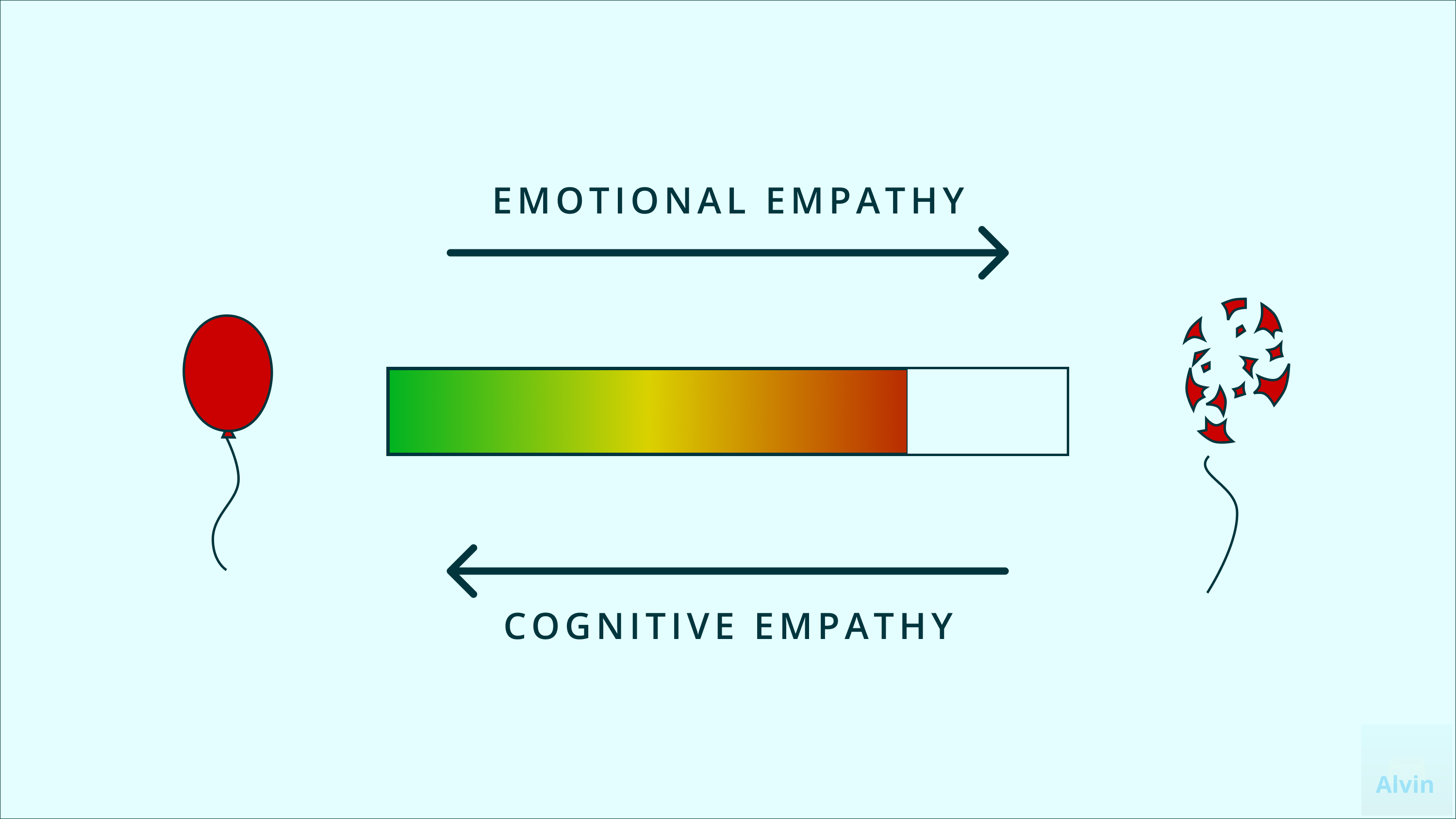
Cognitive empathy is about understanding what someone else is feeling or thinking.
Emotional empathy is about feeling what someone else feels.
When people point out examples of good empathy, it’s almost always the emotional type. Because tears (and emotions, in general) are more visible than “understanding.” But emotional empathy has a dark side that’s underestimated.
Emotional Empathy: A Double-Edged Sword
Emotional empathy involves taking on the emotional weight of another person, but it comes at a hefty cost. Because emotional empathy does not offer an easy way to relieve that emotional weight. So, when we feel overwhelmed, we often withdraw ourselves, numb our emotions, or avoid triggers, which only masks and suppresses emotional pressure temporarily.
There’s only so much pain a person can take.
Some would say we can also cry until the emotions fade with time. But that doesn’t work if we’re exposed to tragic fear-mongering rage bait from the internet 24/7. That doesn’t work if we’re fed emotional baggage faster than we can release it.
Being overwhelmed by pain and emotion doesn’t just break you down; it takes a toll on those around you, too.
Bob was so distressed by the news that he couldn’t go outside for his usual stroll around his neighbourhood. Imagine an elderly lady who could use help carrying groceries back to her house. Because Bob wasn’t out and about, the people in his community had one less person present to help them. It gets worse…
It turns out taking on another person’s emotional baggage doesn’t lighten the load on anyone. If Alex lost a loved one, and Chris exercises emotional empathy by feeling the same pain, Chris might help Alex feel understood. But unless that shared pain is resolved through action or support, the suffering remains. So where before just one person was suffering, now there are two. That means that not only does being overwhelmed stop you from helping others; it also grows the amount of suffering in the world.
So, if we genuinely want to help others, we need to prevent emotions from overwhelming us by taking on less of another’s pain.
It’s self-care.
None of us can empathize with everyone. Attention and emotional energy are limited. So, empathy is always selective, whether we realize it or not. The only real question is whether who we empathize with is intentional or whether it’s dictated by others.
Don’t get me wrong. Emotional empathy is important. It can motivate us to help others. But that doesn’t mean we should let it drive our lives into the ground. And that raises the question: how do we maintain empathy without letting it overwhelm us?
I know some people will say, “but feeling someone’s pain motivates us to care for one another.” Yes, it can. But…
Cognitive Empathy: Understanding Without Absorbing
Feeling someone’s pain isn’t necessary to motivate care. In fact, we help others without taking on another’s pain all the time.
If your child gets a paper cut on their index finger and starts bleeding, you’re going to grab a bandage right away without the need to feel the child’s pain first.
Emotional empathy isn’t needed for action because there are other ways to drive action to relieve pain.
Principles.
Social norms.
Courtesy.
And just noticing when someone else is inconvenienced.
This is where cognitive empathy and compassion come in. Because understanding and caring about another is driven more by thinking than feeling. The thinking part puts your mind into a problem-solving mode that acts as an emotional release valve. Because once you solve the problem causing the suffering, the emotional baggage that came with it dissipates. So, we have far greater capacity for cognitive empathy and compassion because they create space for action. Emotional empathy alone does not.
We now know how empathy and compassion work, but there are still limits to how much we can apply each. We can only understand and care about so much each day. So, how do we choose where our attention goes? Here’s the key:
Empathy and compassion are not ends in themselves; they are tools.
Choosing Where Care Belongs
Empathy is about connection. It’s valuable because it lets you connect with others to forge relationships and achieve goals you can’t achieve on your own. People often forget that empathy isn’t just about suffering. If your friend is getting married and you feel their happiness, that’s also empathy. Since empathy is about connection, it’s more powerful when we focus it on those closest to us relationally.
Compassion is different. It has more to do with caring about another person’s well-being and wanting to relieve their pain. Because compassion is tied to action, it’s most effective when focused on those closest to us in terms of responsibility, influence, and practical proximity. Those we are most able to help.
So, in a broad, practical sense, it helps to focus our care first on those who are closest to us in our lives.
Having empathy and compassion for all human beings is a noble goal, but it’s a mistake to start there. Especially before you have your own affairs in order.
Now, you might think, “Alvin, that’s as obvious as ‘potato chips are bad for you.’” Yet that doesn’t stop people from eating potato chips. Centuries ago, people could mainly engage with others closest to them. As technologies advanced, people could keep up with others over longer distances. The internet took this to a whole other level. Yet even our ancestors knew we need to manage empathy and compassion methodically to keep our sanity.
Roman philosopher Hierocles introduced “circles of concern” or “Hierocles’ concentric circles” in the second century CE.
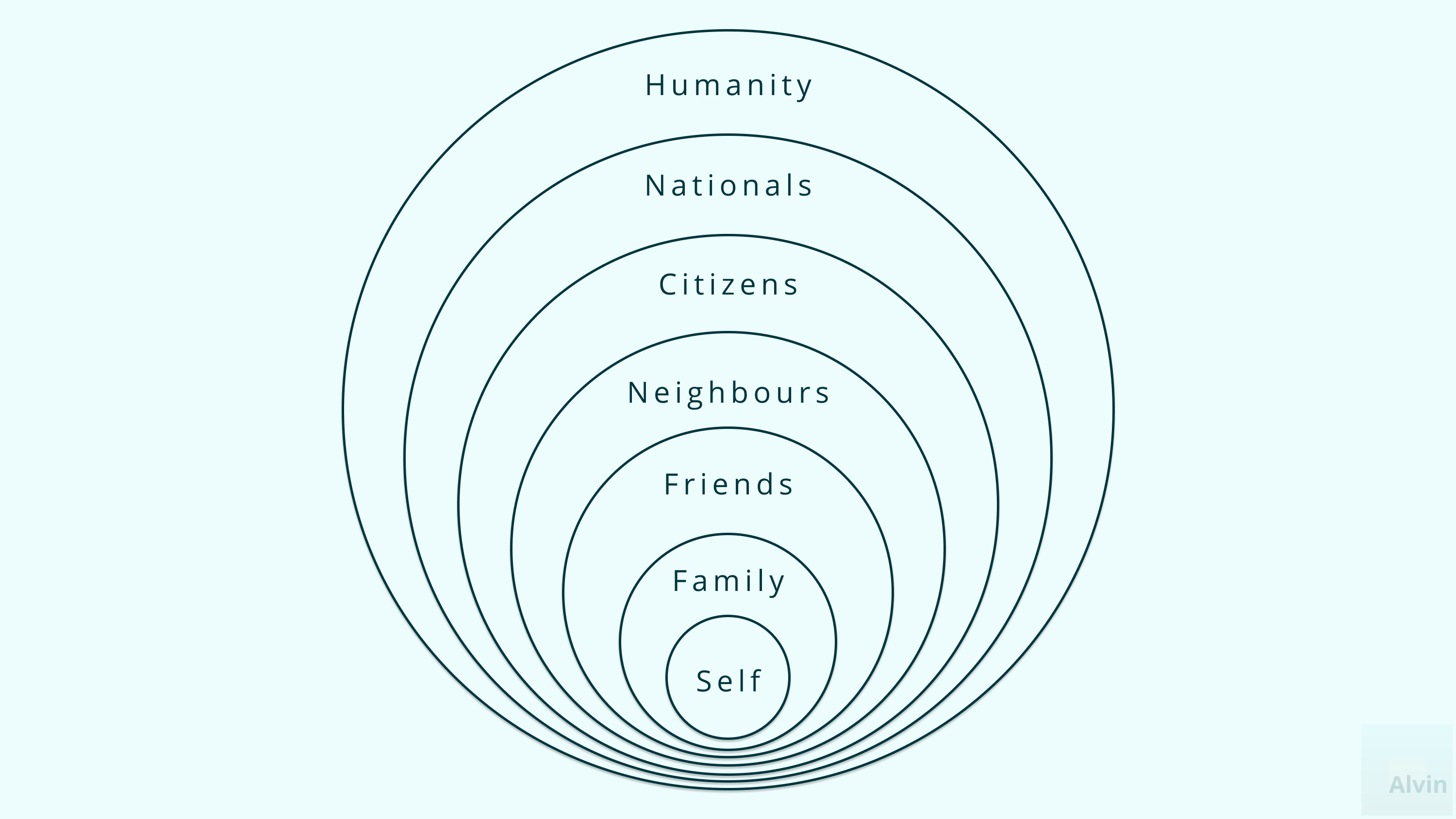
The circle in the middle represents you. Your mind and body as one. You’re enclosed within a larger circle representing your family, which is enclosed in a larger circle representing your friends… in a larger circle representing your community… then your city… your country… and eventually all of humanity.
There are different variations of this concept. Some might include citizens of a country. Others might break down “family” into siblings and parents. But the key is the same: each larger circle represents a group of people more socially distant from you. And:
“According to his [Hierocles’] view, each of us has a duty of mutual aid towards every other human being—but a weightier duty towards those who are socially closer than those who are more distant.”
- Professor Ralph Wedgwood on Hierocles’ Concentric Circles
To be clear, Hierocles was not saying that you should just focus on people socially closer while ignoring everyone else. But he also wasn’t saying that you should be equally empathetic and compassionate to everyone.
The idea is to sort out your own affairs first. Then help those in the next biggest circle, like your parents and siblings. Once you can do that consistently, you can help your friends. But you don’t want to focus on the bigger, distant circles before you address the smaller, closer ones.
It’s about practicality.
How can you help others if you can’t even help yourself?
The ultimate goal is to have empathy and compassion for all human beings as if they’re your “brothers and sisters.” Even if they’re technically not.
It takes intentional practice to wield empathy and compassion in a way that helps people. That’s why empathizing with everyone too soon sets you up for burnout, compassion fatigue, and failure.
Ancient Wisdom in an Age of Overload
Our ancestors understood the nuances of empathy and compassion and knew how to work with those minutiae. It’s wisdom modern society largely forgot.
Aristotle, for example, was all about pursuing happiness and flourishing. Part of that means applying virtues to guide our behaviours. But true virtue lies between two extremes: deficiency and excess. For example:
Courage lives between cowardice (deficiency) and recklessness (excess).
Confidence lives between self-deprecation (deficiency) and arrogance (excess).
Empathy lives between insensitivity and emotional overwhelm.
A surgeon who is callous is dangerous.
A surgeon who faints at the sight of blood is useless.
God, grant me the serenity
to accept the things I cannot change
the courage to change the things I can
and the wisdom to know the difference.
Nowadays, we’re often told that when someone feels bad, we’re supposed to feel bad with them. It’s why there’s general anxiety, misery, and anger in the world.
We’re constantly exposed to emotional cues telling us how we’re supposed to feel. From anxiety to misery to outrage. We’re told that other people are miserable, so we should be miserable, too. But emotional alignment isn’t the same thing as effective action.
We now know that being miserable doesn’t solve problems. It multiplies them. The good news is you have a choice:
You can become miserable like everyone else. Overwhelmed by so much emotion, you can’t even leave your home.
Or you can draw courage from deep within yourself and say, “I can deal with this.” Or better yet, “I’ll fix this so no one else has to suffer the way I did.”
The goal isn’t to feel everything.
The goal is to help where we actually can.
Reply to belowthesurfacetop@gmail.com if you have questions or comments. I’d love the hear from you. By the way, I explored a way to avoid emotion overload by steering your emotions in Dive 80. Be sure to check it out:

Thank you for reading. Empathize cognitively. And I’ll see you in the next one.