


Hey, it’s Alvin!
Over the years, I noticed a key distinction between those who conquer challenges and those who don’t.
Those who achieve consistent successes are masters of conquering what I call the pit of learning.
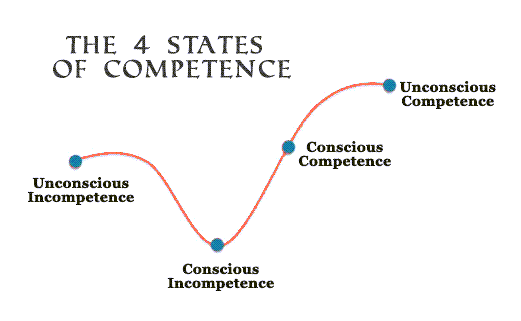
Learning anything new is about building competence. And if you search online for “competence curve,” you’ll find graphs like this:
This Dunning-Kruger one is also pretty popular:
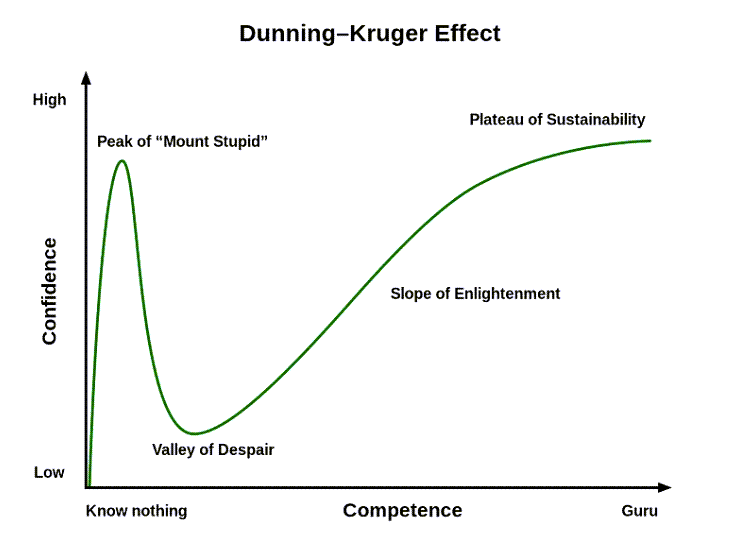
You’ll notice they both follow a U-shape. “The pit” is the bottom of the U-shape, which represents “conscious incompetence,” or the “Valley of Despair.” That both graphs follow a U-shape is not a coincidence.
On the surface, they represent different phenomena. But at their core, they all represent the experience of a learning process.
ANY learning process.
Whether you’re…
Learning a new job
Learning to adapt to a new culture
Learning to get along with someone
In my experience, the hardest parts are falling into the pit and beginning the crawl up and out. Those are parts of learning where most people quit. But quitting too early and often means we never develop the resilience to overcome obstacles.
We don’t grow.
We don’t accomplish our goals.
We don’t connect with others deeply and authentically.
While there’s plenty of advice on how to get out of the pit when you’re in it, there’s not much on how to set yourself up for success before starting a journey. For starters, I find the dip has less effect on those who love learning for two reasons:
They make the dip feel shallower.
They get in and out of the dip as fast as possible.
Let’s use “culture shock” as an example.
Culture Shock
Sometimes, when people talk about culture shock, they’ll show a graph that has a familiar shape:
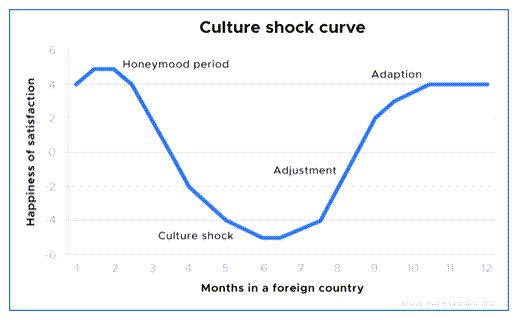
When you first arrive in a new country, everything about it will be refreshingly new. If it’s a country you admired from afar, you’ll see everything in the best possible, romanticized light.
This is “the honeymoon phase.”
Tourists never stay long enough to leave the honeymoon phase. When a tourist visits the same country later, the tourist enters another honeymoon. I have friends who love Japan. Every time they return, they gush about heated toilet seats, vending machines on every street corner, and spectacular service.
But once you decide to stay in a new place indefinitely, you have to start integrating into the local culture. That leads to the dip. The culture shock. The state of being overwhelmed by having to learn new ways of doing things and new obligations. Not to mention new languages just to survive day-to-day.
That’s when some foreigners notice that their Japanese home is smaller than they’re used to back home. That it lacks central heating. Now that they have to work in Japan to make a living, they realize they have to provide the same quality level of service to customers they loved receiving as tourists. Even when the customers are abusive. All of this adds to the culture shock.
But there are ways to pre-emptively dampen the shock. And the greatest problem solvers show us how.
Dampening the Shock
1. Be realistically optimistic.
One of the most beneficial things I learned from the best in my field of software development is that all the greatest problem solvers in the world have the same dual mindset:
They’re pessimistic enough to see all that can go wrong with their solution…
But optimistic enough to address all the issues.
This realistic optimism is key to perseverance because it helps you overcome the pit of learning.
It’s too easy to over-romanticize a place when it looks so perfect on every travel brochure, tourist website, movie, or travel blog. By acknowledging that every place has its pros and cons, we ground our expectations to be more realistic. That way, when we encounter unpleasant or challenging aspects of a culture, we’re not caught off guard.
If you expect the dip, the dip won’t feel so devastating.
2. Plan for the challenges ahead.
Once you know some challenges you’ll face, you can plan for them. At best, you can find solutions to prevent problems. If not, you can look for workarounds. At the very least, you know what’s coming.
It’s like you’re a passenger in a car at high speed. If you can see that you’re quickly approaching a traffic jam, you would expect the driver to brake hard. So, when it happens, you’re mentally and physically prepared for it. But if you’re on your phone, and the driver suddenly brakes hard, you’ll have heart-stopping whiplash.
It’s tempting to assume that looking for imperfections might ruin the fun. But in my experience, diving deeper into the pleasant and less pleasant features of a place makes it more fascinating.
For example, you might learn that the prevalence of heated toilet seats in Japan might be because many Japanese homes don’t have central heating. If you need to visit the bathroom in the middle of a cold winter night, the heated seat offers comfort in a room that could double as a fridge.
Or you might find there are vending machines around every street corner because Japan can get searing hot. And Japanese people often live in tiny apartments where they don’t have space to store cases of drinks.
All of this can be researched before moving over there, setting expectations closer to reality, dampening the dip of culture shock when it happens. Finding ways to overcome these challenges beforehand also lets you move in and out of the dip faster because you’ll have less to sort out if or when you find yourself in the chaos of culture shock.
This isn’t about culture shock
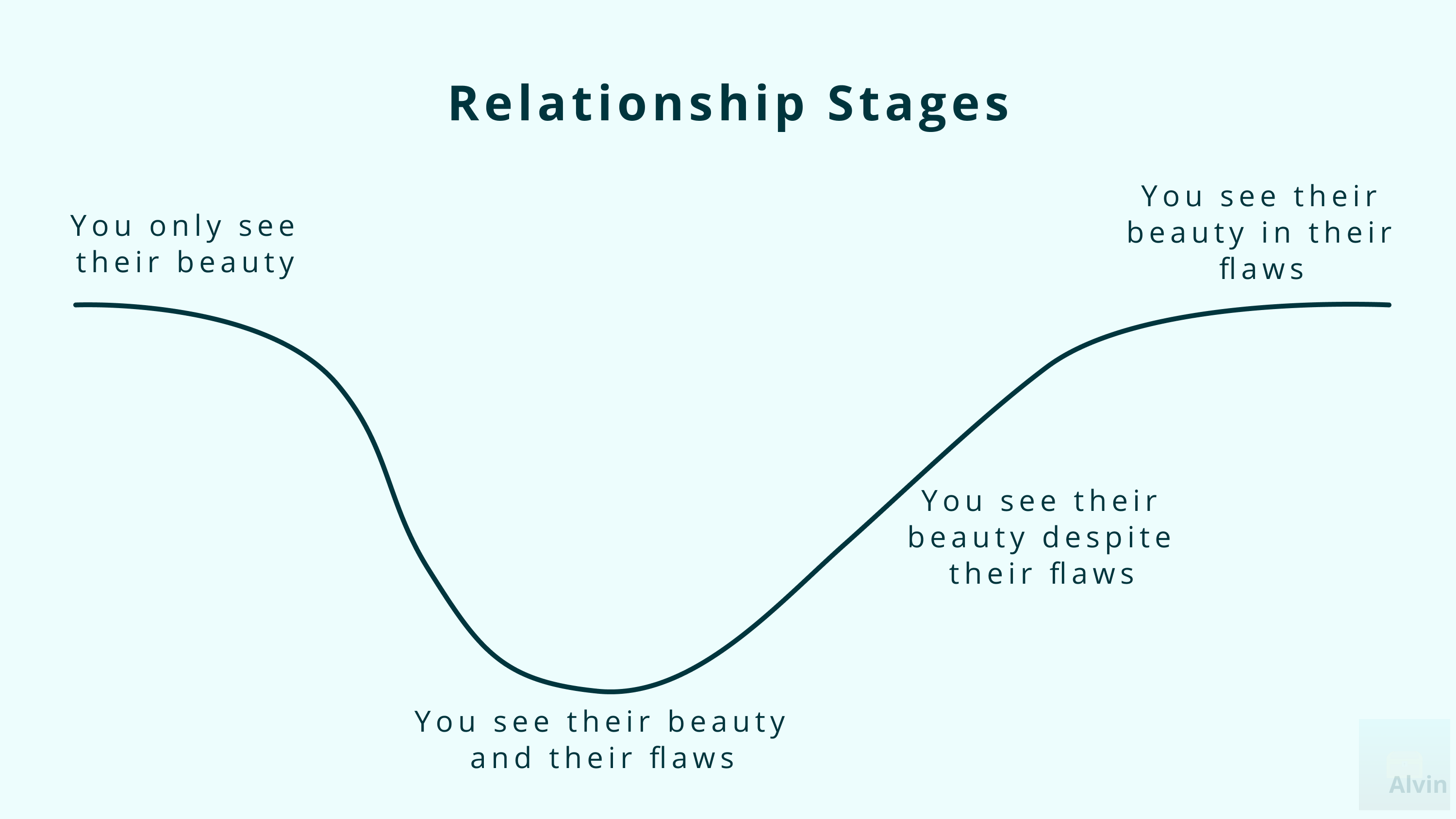
I used culture shock as an example of a dip in every learning process. But the U-shaped curve is what you can realistically expect to experience whenever you learn anything. It even applies when you’re learning to get along with a new friend, romantic interest, or business colleague.
When you first meet a person, you’ll both make the best picture-perfect first impressions you can.
As you get to know each other better, you’ll find flaws, differences in opinion, etc.
Characteristics that get on your nerves.
But as you move past that dip, you’ll slowly piece the good and the not-so-good together to form the fuller picture of who this person truly is. Until eventually, you appreciate the whole person. Strengths and weaknesses. Flaws and all.
The dip is unavoidable.
But we can dampen the dip with realistic optimism. Which means:
Expect challenges, but believe in your ability to conquer them.
Then, plan ahead to smooth the journey as much as possible.
What we want is to persevere through learning processes so we can live more in tune with a meaningful life.
Life is a bag of apples. My favourite cultivar is the Ambrosia because the local ones are sweet, juicy and fragrant. Not all equally so. But even if an individual apple isn’t as juicy and sweet as the previous one, I still appreciate the bag or cultivar. As a whole. Because overall, they’re tasty. That’s the difference between a tourist and a local.
The word tourist isn’t just a category of people. Tourist is also a mindset. A beginner’s point of view. Through learning, you go from a tourist to a local.
The tourist appreciates only the sweetest apples.
The local appreciates the cultivar.
Who do you think appreciates their bag of apples more?
Reply to belowthesurfacetop@gmail.com if you have questions or comments. I’d love to hear from you.
I also wrote about my U-shaped learning experience of adapting to harsh, snowy Canadian winters back in Dive 17: The Joy in Pain. You can read about my adventures there.

Thank you for reading. Practice realistic optimism. And I’ll see you in the next one.